
Home › Cases
How do you get a team that works with data instead of requesting reports?
By training people on their own data rather than on a demo set, and by making sure someone owns each figure. A team that only requests reports stays dependent on whoever builds them. We combined short training rounds with real questions from their own work, so the first useful answer came from the participants themselves.
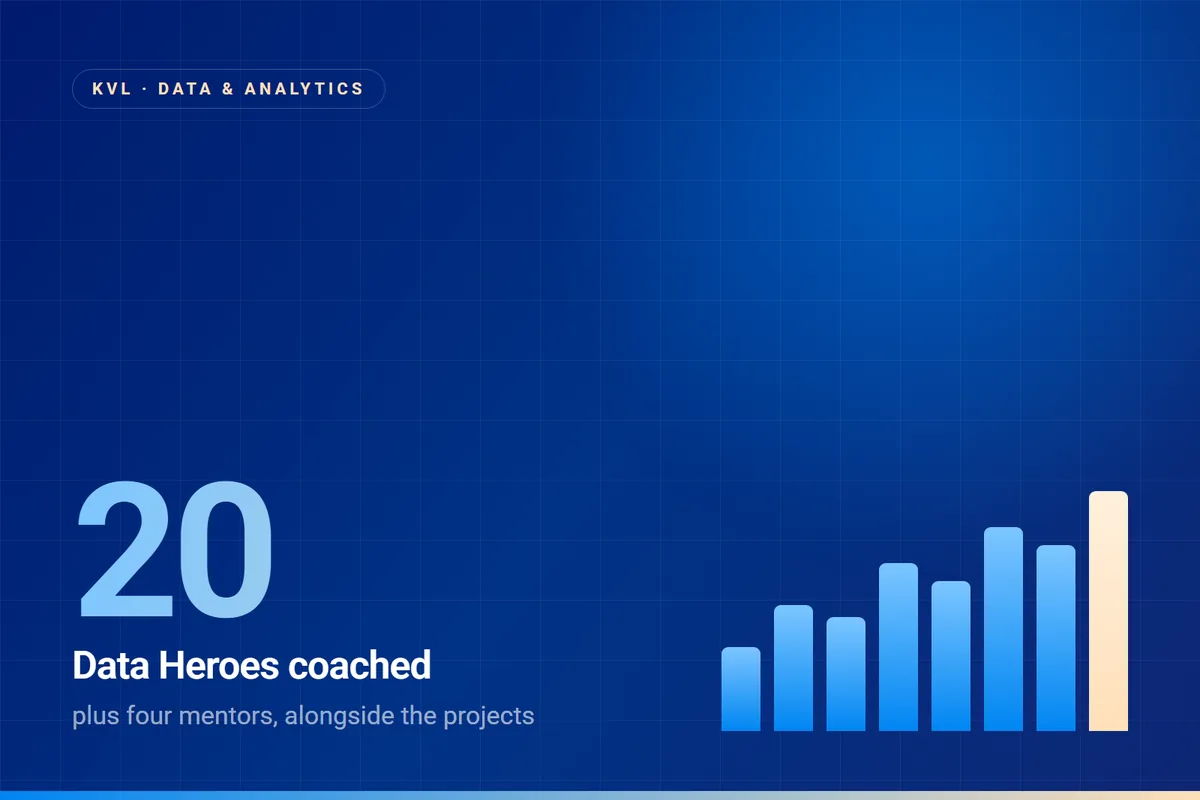
Education and training Power BI, Microsoft 365
The challenge
Reporting worked, but every new question went through the same small group. That made the team dependent, slowed decisions down, and meant the people who knew the business best were furthest from the data.
Our approach
Short training rounds on the organisation’s own data, not on a demo set, with real questions from participants’ daily work. Alongside that, we recorded who owns which figure and what it means, so an answer could be checked rather than taken on trust.
Results
Routine questions stopped going through the specialist. Participants built and adjusted their own views, and the specialist time freed up went to the harder work underneath.
Expertise involved
Power BI, data modelling, and the part that is not technical: getting ownership assigned and definitions agreed so the training has something to hold on to afterwards.
See also
Read on
Half an hour is enough to know whether we fit
No slide deck and no quote at the end. We walk through your sources, your definitions and your biggest frustration.
Book half an hourFrequently asked questions
Why does regular Power BI training often not stick?
Because it is given on a demo data set. People learn which buttons exist but not how their own figures behave. Training on the organisation's own data is harder to prepare and far more likely to be used the week after.
What does adoption need besides training?
An owner per figure and a place where the definition is recorded. Without those two, people fall back on asking the one person who knows, and the dependency returns within months.
How long does it take before a team is self-sufficient?
For a first group, a few rounds spread over several weeks, with real questions from their own work in between. Self-sufficient does not mean nobody asks anything any more; it means the routine questions no longer need a specialist.