
Home › Cases
How do you migrate 200 Oracle reports into 75 Power BI dashboards?
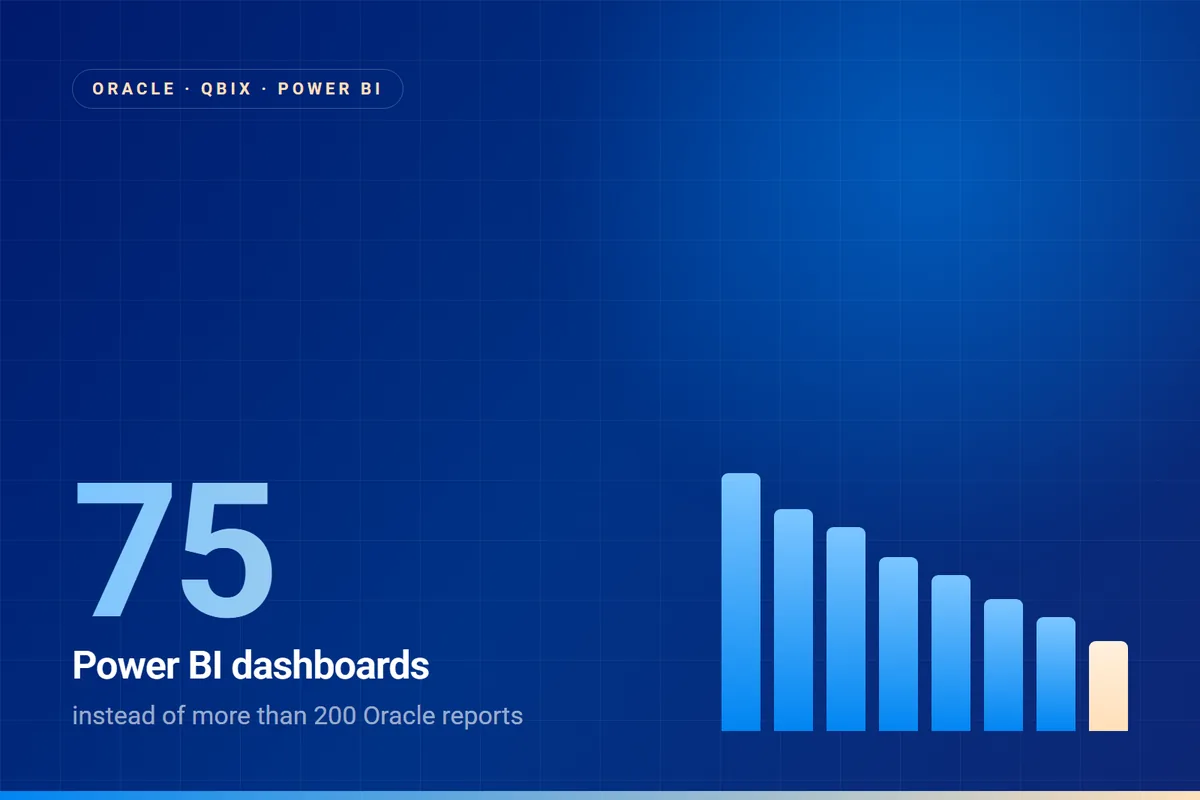
By asking which reports are actually used before migrating anything. More than 200 Oracle reports had accumulated over the years, many of them variations on the same question. We mapped usage and overlap, and rebuilt what was left as 75 dashboards on a modelled source. Fewer reports, used more.
Water authority, public sector Oracle, Power BI, SQL Server
The challenge
A water authority had accumulated more than 200 Oracle reports over the years. Nobody had an overview of which were used, which duplicated each other, or which numbers were still correct. Every new question produced another report.
Our approach
We started with usage rather than with technology: which reports are actually opened, by whom, and what question do they answer. That produced a much shorter list than the count suggested. Overlapping reports were merged, unused ones retired, and the remainder rebuilt on a modelled source instead of on direct queries against the operational database.
Results
More than 200 Oracle reports became 75 Power BI dashboards. Fewer of them, opened more often, and on a model where a figure means one thing. The reduction was not the goal in itself; it was the consequence of asking what each report was for.
Expertise involved
Report landscape analysis, data modelling on a star schema, migration from Oracle to Power BI, and the conversations required to retire a report someone built years ago.
See also
Read on
Half an hour is enough to know whether we fit
No slide deck and no quote at the end. We walk through your sources, your definitions and your biggest frustration.
Book half an hourFrequently asked questions
Why did 200 reports become 75?
Because a large share of them were variations on the same question, built at different times for different people. Once the underlying model is right, one dashboard with a filter replaces five near-identical reports.
How do you decide what not to migrate?
By looking at actual usage rather than asking who wants to keep theirs. A report nobody has opened in a year is a candidate to retire, and that conversation is easier with the usage figures on the table.
What happened to the Oracle environment?
It stayed in place as a source. The reporting layer moved, not the systems underneath, which kept the migration to one clearly bounded piece of work.